
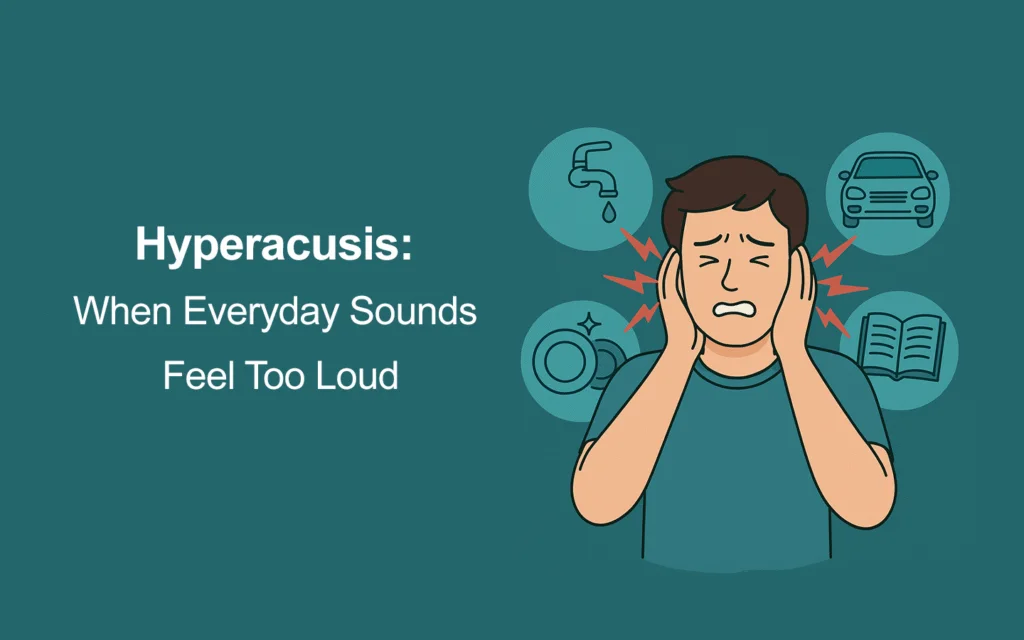
Have you ever felt like everyday noises, the hum of the fridge, clinking dishes, or even someone laughing were just too much for your ears to handle? If so, you might be experiencing something called hyperacusis.
At Tinnitus Connect, we talk to many people who feel frustrated and anxious because normal sounds seem unbearably loud. The good news? You’re not alone and there are ways to manage it.
What Is Hyperacusis?
Hyperacusis is a condition where your ears become oversensitive to sound. Unlike people with normal hearing, who can comfortably listen to sounds up to about 100-110 decibels (dB) (the level of a loud concert), people with hyperacusis often find sounds uncomfortable at much lower levels sometimes even around 70-80 dB (like busy traffic or a vacuum cleaner).
That’s why something as simple as a clattering plate or barking dog can feel overwhelming or even painful.
How Much Sound Is “Too Loud”?
- Normal hearing: Most people tolerate sounds comfortably up to 100-110 dB.
- Hyperacusis: Discomfort often starts around 75–85 dB, sometimes even lower (Anari et al., 1999).
- Mild cases: Discomfort starts around 80 dB.
- Severe cases: Even 60 dB (the sound of a normal conversation) can feel unbearable (Brain Injury Explanation, 2023).
Audiologists measure this using something called the Uncomfortable Loudness Level (UCL) or Loudness Discomfort Level (LDL). If your LDL is much lower than average, that’s a sign of hyperacusis.
Why Do Some People Become Over-Sensitive to Sound?
There isn’t just one cause. Hyperacusis can happen for many reasons, including:
- Noise exposure (concerts, machinery, headphones at high volume)
- Head injury or concussion
- Ear conditions (like Ménière’s disease)
- Neurological conditions (like migraines, Lyme disease)
- Associated conditions – Hyperacusis is often linked with tinnitus, and up to 86% of people with tinnitus also experience hyperacusis (Baguley, 2003).
Sometimes, hyperacusis appears suddenly without a clear cause which can be the hardest part for patients.
Treatment Options for Hyperacusis
There isn’t a one-size-fits-all cure, but there are effective ways to manage it and reduce its impact on your daily life:
Sound Therapy
- Gentle exposure to soothing sounds (like soft music, pink noise, or nature sounds) helps “retrain” the brain to respond more calmly.
- Often used as part of Tinnitus Retraining Therapy (TRT).
- Gentle exposure to soothing sounds (like soft music, pink noise, or nature sounds) helps “retrain” the brain to respond more calmly.
Cognitive Behavioral Therapy (CBT)
- Helps reduce the anxiety and stress that come with sound sensitivity.
- Teaches coping strategies so you can feel more confident in everyday environments.
- Helps reduce the anxiety and stress that come with sound sensitivity.
Smart Use of Ear Protection
- Earplugs or earmuffs are helpful in very loud places.
- But avoiding sound completely can make hyperacusis worse. Balance is key.
- Earplugs or earmuffs are helpful in very loud places.
Medical or Surgical Options
- In rare cases, treatments like round/oval window reinforcement surgery have shown improvement in sound tolerance (Wikipedia, 2023).
- In rare cases, treatments like round/oval window reinforcement surgery have shown improvement in sound tolerance (Wikipedia, 2023).
How Tinnitus Connect Can Help
At Tinnitus Connect, we know how tough hyperacusis can be. Many of our clients tell us they feel isolated, anxious, or even scared of everyday sounds. That’s why we focus on compassionate, personalized care:
- ✅ Audiological assessments to measure your comfort levels with sound
- ✅ Individual sound therapy plans tailored just for you
- ✅ CBT and counseling support to ease stress and anxiety
- ✅ Guidance on healthy ear protection so you can feel safe without overprotecting
- ✅ A caring community where you’ll always feel understood and supported
You don’t have to go through this alone. With the right strategies and support, it’s absolutely possible to reclaim your confidence and enjoy life again.
Final Thoughts
Hyperacusis can make the world feel unbearably loud, but there is hope. By understanding your triggers, working with audiology professionals, and using evidence-based therapies, you can take control of your sound environment instead of letting it control you.
At Tinnitus Connect, we’re here to walk with you on every step of that journey.
References
- Anari, M. et al. (1999). Clinical characteristics of patients with hyperacusis. PMC4432660
- Cleveland Clinic (2022). Hyperacusis: Symptoms, Causes & Treatment. Cleveland Clinic
- Frontiers in Neuroscience (2022). Uncomfortable loudness levels and hyperacusis diagnosis. Frontiers
- Brain Injury Explanation (2023). Hyperacusis severity levels. Brain Injury Explanation
- Wikipedia (2023). Hyperacusis. Wikipedia