
Hey there if you’ve ever had a ringing, buzzing, hissing, or “whooshing” in your ears and wondered, “why me?”, you’re not alone. That phantom noise is called tinnitus sound. And yes, for many, it has a close relationship with hearing loss.
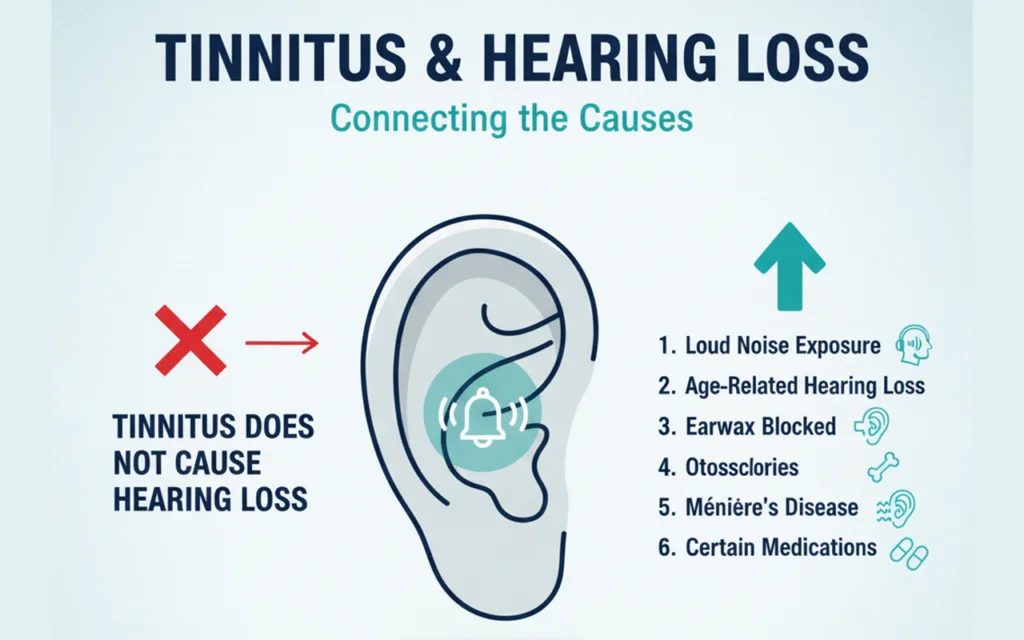
How Tinnitus and Hearing Loss Are Connected
When some hair cells in your inner ear are damaged whether from loud noise, aging, or other causes fewer nerve signals are sent to your brain. Your brain, ever adaptive, tries to make up for the missing input by “turning up the internal volume.” That boost often manifests as tinnitus sound.
You might wonder: can tinnitus cause hearing loss? While tinnitus itself isn’t typically the direct cause of hearing loss, it often signals underlying damage in the auditory system. Essentially, the same factors that trigger tinnitus can also impair hearing.
- Did you know? Most people with tinnitus also have some degree of hearing loss. Population studies show:
- About 1 in 3 tinnitus sufferers (≈35%) have measurable hearing loss on standard hearing tests.
- Other surveys report that around 60% notice difficulties with hearing.
- Clinical reports suggest the overlap may be as high as 80-90%, especially in older adults or those exposed to loud noise.
The bottom line: tinnitus and hearing loss are deeply connected, so checking your hearing is a crucial first step in managing that ringing.
On the flip side, not everyone with hearing loss experiences tinnitus. Two people with similar auditory changes might react differently one barely notices, while the other is deeply troubled. The difference often lies in how the brain’s emotional and attentional circuits respond to the tinnitus sound.
Identifying Hearing Loss: Why It Matters
Because underlying hearing loss often drives tinnitus, detecting and managing it can reduce the brain’s need to “compensate” so aggressively.
What you can do
See an ENT or audiologist: Hearing tests like audiograms, extended high-frequency audiometry, and otoacoustic emissions can detect hearing loss or cochlear damage.
Address reversible causes: Sometimes infections or middle ear problems (a common disease that causes ringing in ears) can be treated directly.
Sensorineural damage: Age-related, noise-induced, or genetic damage may benefit from hearing aids or amplification devices to restore input and reduce the brain’s overcompensation
Sound therapy / masking: Gentle background sounds help reduce the contrast between silence and the tinnitus sound, making it easier for the brain to ignore.
Counseling and habituation strategies: Education, cognitive therapy, and habituation techniques can retrain your brain’s reaction to tinnitus.
The Bottom Line
If you’re experiencing persistent ringing or buzzing, don’t ignore it. Visit your audiologist, rule out hearing loss, and explore management options. Understanding the link between tinnitus and hearing loss is the first step toward relief.
At Tinnitus Connect, we offer a management program designed to help people live better with tinnitus, whether through coping strategies, sound therapy, or hearing support.